Ready-to-fund projects that save lives when every minute counts
Seven initiatives that narrow the emergency-preparedness gap in Arab society in Israel, from defibrillators in village centers to light towers at disaster sites. Each one scales: partners can fund a single unit or an entire program.
S.A.R. ProArt for ResilienceThe Heart of the VillageLet There Be Light
About Sadad Center
Strengthening emergency preparedness for Arab citizens of Israel
Our goal: to equip Arab communities across Israel with the knowledge, tools, and connections to protect their residents when the next crisis comes, whether war, earthquake, or pandemic.
The need
Since March 2020, emergency has become routine in Israel: COVID-19, October 7 and the war in Gaza, and repeated campaigns against Hezbollah and Iran.
Arab citizens entered this period with major gaps in shelters and infrastructure, emergency services, trained volunteers, and civil society capacity, as well as a lack of awareness.
One in five Israelis is an Arab citizen, and the vast majority of Arab citizens live in Arab localities. Yet:
0.3%Only 37 of 11,738 public shelters are located in Arab localities.State Comptroller's Report, 2026
<5%Only 900 of 20,000 nonprofit organizations were founded in and operate within Arab society.Ministry of Justice
~2.7%Only around 40 of Israel's 1,500 psychiatrists are Arab.Ministry of Health
A coordinating body must be established to mobilize government ministries, local authorities, and relevant organizations to address the disparities affecting Arab society.
Office of the State Comptroller and Ombudsman, January 2026
Closing these gaps makes Arab citizens safer and all of Israeli society more resilient.
Who we work with: three core arms
Government ministries
Embedding policies and operating methods adapted to Arab society, and securing an equitable share of resources.
Local government
Building the organizational resilience of Arab local authorities and their capacity to manage emergencies.
Civil society & community
Mobilizing local organizations and building community readiness, a critical layer of emergency response.
What we work on: four focus areas
Infrastructure
Shelters, safe rooms, and emergency equipment.
Resilience
Civil society capacity and volunteer training.
Awareness
Public outreach and access to rights.
Knowledge hub
Mapping gaps and barriers, and expert consulting.
Origins and leadership
Days after October 7, 2023, Sadad's founders, then civil servants, established the government's Emergency Support and Information Center for Arab Society in Kafr Qasem, in cooperation with the Home Front Command, the police, and Arab local authorities. When the center closed about a year later, the need remained, as did their commitment. In late 2025, they established Sadad as an independent nonprofit to give this work a permanent home. During Operation Roaring Lion (February 2026), Sadad trained volunteers nationwide in search and rescue, community resilience, and emergency medical care.
The board is chaired by Hassan Tawafra, former head of the Authority for Economic Development of the Minority Sector. Executive Director Roey Yessod established and directed the government's emergency center and previously served as General Secretary of the General Federation of Working and Studying Youth. Other founders include Adv. Raed Daka, Mayor of Baqa al-Gharbiyye, and Dr. Sigal Shelach, former CEO of JDC.
Partnership opportunities
Seven projects, one goal
Each initiative below meets a concrete need on the ground and can be scaled to different funding levels.
01
Emergency medicine
The Heart of the Village
Closing the gap in access to defibrillators in the cores of Arab villages.
From$2,700 / station
02
Protection
Art for Resilience
Turning neglected mobile shelters into safe, usable and welcoming spaces.
From$3,030 / shelter
03
Search & rescue
S.A.R. Pro
Advanced training for volunteer search-and-rescue teams to respond to major emergencies.
From$12,100 / team
04
Civil society
NGO Ready Fund
Funding and mentoring Arab nonprofits to build emergency response plans.
From$8,800 / nonprofit
05
Protection
Right to Protection
Helping Arab families near the northern border claim government safe-room grants.
Annual budget$104,500 / year
06
Emergency medicine
EMD Pro
Training and equipping local medical first responders.
From$30,250 / course
07
Search & rescue
Let There Be Light
Lighting disaster sites for rescuers when the power fails.
From$19,000 / tower
Make it yours
Fund one unit, a full program or the whole portfolio
Tell us what matters to you and we'll put together the right package.
Filling the gap in accessible defibrillators in Arab municipalities
10%drop in survival odds for every minute without defibrillation
8,000–13,500cardiac arrests in Israel every year
85Arab municipalities, one station each
The challenge
Israel sees 8,000–13,500 cardiac arrests a year. According to Magen David Adom (MDA), Israel's national emergency medical service, survival odds drop 10% for every minute without defibrillation, which is most effective within one to three minutes.
The 2008 Placement of Defibrillators in Public Places Law requires every public institution, shopping center, or workplace with more than 500 people a day to have a visible, accessible defibrillator.
Arab municipalities have far fewer such sites than Jewish-majority municipalities, so the law requires fewer defibrillators there, leaving a significant gap in coverage.
The gap is clearly visible on GovMap, the government's mapping platform, and in defibrillator-locator apps.
Arab village centers are densely built and only partly reachable by road, which makes a nearby defibrillator all the more important.
The opportunity
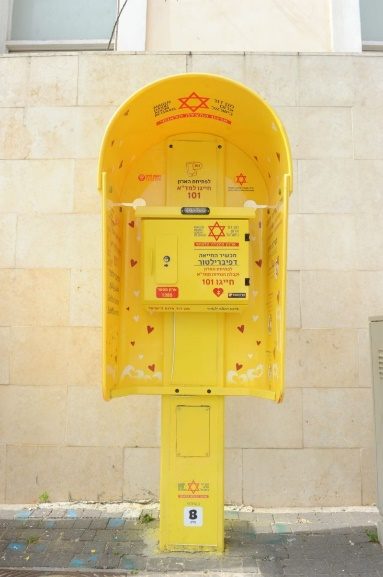
Install a publicly accessible, GPS-monitored defibrillator station in the village core of each Arab municipality.
How it works
Al-Hayan, an Arab community health organization that works closely with MDA, will install and maintain the stations.
Defibrillator stations in Ramat Gan and Rishon LeZion, and GovMap showing the gap in defibrillator coverage.
02Protection
Art for Resilience
Turning neglected mobile shelters into safe, usable, and welcoming spaces
Hundredsof mobile shelters installed across Israel since October 2023
3 upgradessolar lighting, a steel door and an original mural
100shelters in the full program
The challenge
Between October 2023 and Operation Roaring Lion in March 2026, hundreds of mobile shelters (small prefabricated concrete structures) were installed across Israel in areas where residents lacked protection from rocket and missile fire.
In Arab localities, they were placed in residential neighborhoods as well as public spaces, because so many homes have no safe room.
The shelters are now part of the landscape. They provide vital protection, but without upkeep they become eyesores and often hazards: winter refuges for stray dogs and cats, improvised toilets, and more.
Some better-resourced municipalities, mostly Jewish-majority ones, have painted their shelters and fitted them with solar lighting and steel mesh doors. Most Arab municipalities have not.
The opportunity
Transform mobile shelters in participating Arab municipalities, giving each solar lighting, a steel door, and an original mural by an Arab artist.
How it works
The Umm al-Fahm Art Gallery, a partner art school, and Sadad Center will jointly issue an open call and form the selection panel.
The call will invite Arab artists to submit mural proposals.
Approved artists will be paired with participating municipalities, based on the panel's criteria, to paint their shelters.
Each shelter will be fitted with interior solar lighting and a steel door before it is painted.
Each completed shelter will receive a plaque by the entrance bearing the logos of JFNA, Sadad Center, and the municipality.
Examples of solar lighting (Gedera) and a painted mobile shelter (Ganei Tikva).
03Search & rescue
S.A.R. Pro
Preparing volunteer search-and-rescue teams for major emergencies
Since Nov 2023municipalities have been training volunteer rescue teams
~20volunteers in each team
S.A.R. 2advanced training plus a rescue tool kit
The challenge
Missile strikes and earthquakes create the same scenario: collapsed buildings and an immediate need for rescue and evacuation. In a major earthquake, the Home Front Command (the IDF's civil-defense command) could not reach every collapse site at once, so trained, equipped local teams are critical.
Since November 2023, a month after the October 7 attack, municipalities have been training volunteer teams at two levels: S.A.R. 1 (Basic First Response) and S.A.R. 2 (Advanced First Response). These teams are comparable to the Community Emergency Response Teams (CERT) in many US communities.
Municipalities must fund the training themselves, and Arab municipalities generally operate on tighter budgets. As a result, most Arab teams have completed only the basic course.
S.A.R. 2 training also has no practical value unless teams have pneumatic rescue tools on hand.
The opportunity
Bring volunteer teams in Arab municipalities to the advanced level, with S.A.R. 2 training and a rescue tool kit tailored to local needs.
S.A.R. 1 training in Tamra during Operation Roaring Lion.
04Civil society
NGO Ready Fund
Funding and mentoring Arab nonprofits to build emergency response plans
<5%of Israel's nonprofits are Arab, though Arab citizens are 20% of the population
1%of registered volunteers in the nonprofit sector
90%of Arab nonprofits have annual revenue below NIS 500,000
The challenge
In emergencies, communities rely on volunteers and civil society organizations working alongside government services. Yet just when Arab nonprofits should be expanding their relief and support work, they wither instead, and all of Israeli society loses out.
Of Israel's 20,000 active nonprofits, only 900 are Arab nonprofits (less than 5%), even though Arab citizens make up 20% of the population. Arab nonprofits account for just 1% of registered volunteers and 3% of paid employees in the nonprofit sector.
Most are also small: 90% have annual revenue below NIS 500,000.
Many of them struggle to attract and manage donations, either because they lack basic infrastructure or because they do not have Section 46 status, roughly Israel's equivalent of a US 501(c)(3).
The opportunity
Help Arab nonprofits face the next emergency with an Emergency Readiness Package: a response plan plus ready-to-go fundraising briefs.
How it works
Sadad Center will award grants to Arab nonprofits nationwide to write their own emergency response plans and fundraising briefs. The plans will be based on current planning scenarios.
Civil society experts recruited by Sadad will guide the writing. Each nonprofit will have a mentor (covered by the grant) and may consult any of the experts.
Proposed expert partners
Civic Leadership
Forum of Foundations in Israel
Home Front Command Citizen Assistance Center (MARSAL)
Council of Youth Movements in Israel
Mandel Foundation
Maoz
Along with executive directors of nonprofits active in emergencies, such as Amanina and IsraAID.
05Protection
Right to Protection
Helping Arab families near the northern border claim government safe-room grants
NIS 182,000government grant per household for an in-home safe room
~10%participation among eligible Arab households before the resolution
6,000families who will need help at every stage
40 hoursof weekly legal support from Haifa law students
The challenge
Government Resolution 4195, adopted in June 2026, aims to speed up and complete construction of protected spaces in frontline communities 0–9 km (up to about 5.6 miles) from the northern border. It offers each household a NIS 182,000 grant (up from NIS 132,000) to build an in-home safe room, but homeowners must manage construction themselves.
Before the resolution, participation was low overall, and among eligible Arab households it was only about 10%, according to an in-depth study Sadad Center led in Arab localities. The study made clear that without a major change of course, Arab families would largely miss out.
Extensive planning and permitting barriers, more than the size of the grant, had held families back.
Some 6,000 families will need help at every stage: submitting complete, accurate applications, appealing rejections, and building once approved. That requires a support system, including a dedicated outreach campaign, legal aid for appeals, access to bridge loans for construction, and a list of contractors vetted by Sadad.
After the resolution passed, the wartime legal clinic at the University of Haifa Faculty of Law agreed, at Sadad's request, to help families claim the grant. From November 2026, eight second- and third-year law students will each volunteer five hours a week, providing about 40 hours of legal support weekly.
An effort of this scale needs a small, focused unit to drive it.
Establish a Right to Protection Unit at Sadad to help Arab families in frontline communities claim their safe-room grants, in partnership with the University of Haifa's wartime legal clinic.
0–9 kmfrom the northern border: the frontline communities eligible under Resolution 4195
06Emergency medicine
EMD Pro
Training and equipping local medical first responders
75certified, fully equipped EMTs
7–9Arab municipalities
3 × 25three courses of 25 participants
The challenge
When help can't arrive in time: October 7, 2023, and the war that followed showed that every mass casualty incident needs an immediate local response. In a large-scale missile attack or an earthquake, blocked and congested roads would keep Magen David Adom (MDA), Israel's national emergency medical service, from reaching every scene.
The "golden minutes": In the first few minutes, people with severe injuries depend on certified, equipped EMTs on the spot. These EMTs also help keep the public calm.
A clear need and a willing community: Arab communities face a severe shortage of EMTs, and a growing number of residents want to volunteer.
The best of the best: Most emergency volunteers in Arab communities have completed only a basic First Aid Provider course. They form a ready pool from which Sadad Center selects the strongest candidates for full EMT training, a long and demanding program.
A community of emergency volunteers: Sadad is bringing together volunteers trained in search and rescue, emergency medicine, and psychological first aid. Two or three seminars or field exercises a year will keep them engaged.
The opportunity
Train and equip 75 EMTs from 7–9 Arab municipalities, in three courses of 25.
The golden minutesCertified, equipped EMTs on the spot when ambulances can't get through
07Search & rescue
Let There Be Light
Lighting disaster sites for rescuers when the power fails
240 hof runtime before refueling
9 mmaximum mast height (about 30 feet)
4 × 400 WLED lamps
The challenge
Earthquakes, severe storms, floods, and missile strikes that bring down buildings often cause widespread blackouts.
In the first hours after a disaster, every minute counts. Rescue services, volunteer search-and-rescue (Sa'ar) teams, and municipal staff work around the clock in extremely difficult conditions. To keep searching for the injured, clearing rubble, and setting up treatment areas after dark, they need powerful mobile lighting that can be set up quickly.
Many Arab local authorities have no mobile lighting of their own. Their densely built town centers also make it hard for emergency vehicles to get through.
The opportunity
Provide Arab local authorities with mobile, generator-powered light towers.
Mock-up of a branded light tower.
What the light tower provides
Immediate light across large disaster sites.
No reliance on the damaged power grid.
Fewer critical delays in rescue operations and more lives saved.
A charging point for mobile phones, radios, flashlights, and more.
Specifications
Mobility
Can be towed by any vehicle with a tow hitch; no 4×4 required. Weight: about 750 kg (1,650 lb).
Lighting
Four 400 W LED lamps; 95% of power goes to lighting and 5% to the charging outlet.
Raised manually or hydraulically to a maximum height of 9 meters (about 30 feet).
How it works
Supplier tender and purchase.
Donor recognition on each light tower ("Made possible by …").
Delivery to participating local authorities.
Become a partner
Let's build readiness together
Your support builds lasting local capacity in Arab towns and villages. Fund a single unit, a full program or a multi-year commitment, and leave your details or contact Roey Yessod, Executive Director, directly.
Every project scales: choose the number of units that fits your giving.
Donor recognition on equipment and sites, such as plaques and branded light towers.
Costed budgets with transparent project-management fees.